Reading Group KitKit informationKit
View

Text fits your screen. Your place is kept when you change views.

PDF

Jesus in the Air

Excerpt Pack

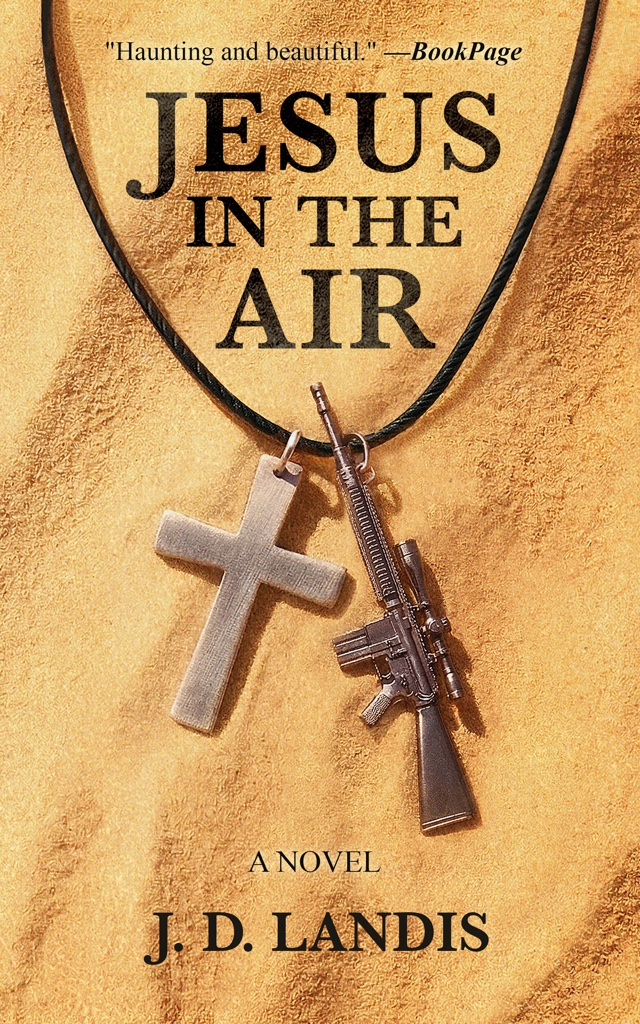
Cover of Jesus in the Air by J. D. LandisJesus in the Air is a novel by J. D. Landis. It follows Warren Pease, a young U.S. Army sniper newly home from Iraq, through one summer day on the New Hampshire coast. Before dawn, he meets a barefoot stranger who asks to be called Ray; Warren knows him as Jesus. As they walk, Warren is drawn back toward the people he left behind and the moral burden he carries home.

Choose one or more excerpts, read them aloud together, then use a few of the questions that follow. No advance reading or copy of the book is required. Groups reading the full novel should use the Book Discussion Guide.

Content Note

These excerpts include non-graphic war memories, firearms, and references to death and grief. You may pass on any question, decline to read aloud, ask for a pause, step out, and rejoin later—no explanation needed.

Contents

Excerpt 1 Footprints in the Dawn

Newly home from Iraq, Warren walks a dark New Hampshire beach and meets a barefoot stranger who calls him by name.

About 6 minutes read aloud · 985 words
page 2

Excerpt 2 At Least to Pray Is Left

A half-staff flag turns Warren’s thoughts to September Eleventh, his mother’s death, his father, and an Emily Dickinson poem.

About 8 minutes read aloud · 1,230 words
page 7

Excerpt 3 A Mother in Mansour

In an Iraq memory, Warren searches a house in Mansour and encounters a grieving mother.

About 9 minutes read aloud · 1,420 words
page 13

Excerpt 4 The Piping Plover

On the beach at night, Warren, Jesus, and Dodie find a piping plover guarding a single egg as gulls circle nearby.

About 5 minutes read aloud · 623 words
page 20

Four Read-Aloud Excerpts and Discussion Questions

Excerpt 1

Footprints in the Dawn

About 6 minutes read aloud · 985 words

I meet Jesus on the day I get home from the war. I’m on the beach, but I don’t know how I got here. My mind is as dark as the night.

I walk, but only back and forth. New Hampshire has a tiny coastline. A lot of it is rock, sent down from Maine when God made the Earth, to keep us on our toes down here. I walk where the sand is wet and hard and cold. It holds my toes, and my toes hold it. In the desert, where I fought, the sand was inhospitable.

The darkness is a gift. I would tell my little baby girl when she woke up in the middle of the night, “Dodie, there’s nothing to be afraid of.” I’ve always loved the dark. In the dark, you light up inside. Things become clearer the darker it is.

Out here, on the beach, I’m alone. I always have been. Or as long as I can remember. As long as since my mother died.

I’d come here in the middle of the night to find myself and to get away from others. The beach is a place of memories. When you come here, you take your life with you. When you go other places, like the city or the desert, you leave your life behind.

I remember everything.

Except how I got here.

I spend the whole night on the beach. But when the sun’s faint light begins to bend around the Earth, I see him.

Out there, ten miles out in the ocean, are the Isles of Shoals. There are nine of them. On the clearest day you can see five at most. They sit like flat gray stones on the skin of the water. If it weren’t for them, your eyes would disappear into the horizon.

Excerpt 1: Footprints in the Dawn

I’ve never been to the Shoals. I’m not a sailor. I’m a soldier. I’ve been content to stand here looking out at them. When there’s haze or fog, or night has set in, I imagine them. They’re always there for me. They make the ocean safe.

They sit off to the east, of course. New Englanders are always looking east. To where we came from. To where we go to fight for freedom. From this coast, the only coast I know, the sun always rises behind the Shoals. Its first light brings them up out of the darkness of the ocean. One by one, they begin to glow.

There, coming toward me, out of the light, is a man. He seems to step on those same islands, one by one, the way I would cross the slippery stones of the Swift River by the Kancamagus Highway up north to try to reach my father.

Behind the man, a faint curtain of light rises to the sky out of the ocean. He wears the light like a robe, though I see he’s dressed like me. Jeans and a T-shirt, no shoes. And that he’s older than I am, a lot older, maybe mid-thirties.

He walks right toward me. He walks right into my eyes.

In the war, we were taught to be suspicious of strangers. That’s what they called it: suspicious. What they meant was fearful: we were taught to be afraid of strangers.

But I’m not afraid of this man. I’m home now. I still don’t know how I got here. But I feel that nothing, and no one, can hurt me.

Still, I want to be alone. I’m thinking, How come on an empty beach if one person puts his chair down and another person arrives, he puts his chair down right near the first person?

He comes right up to me.

“I know you want to be alone, Warren,” he says.

“Do I know you?” I ask.

Excerpt 1: Footprints in the Dawn

“You do now,” he says.

“Well, you don’t know me,” I say. “Anyone who knows me knows I don’t call myself Warren. Nobody calls me Warren.”

“I do,” he says.

“Fine,” I say. “Call me Warren. Who are you?”

“Will you believe me if I tell you?”

“How do I know?”

He nods. “That’s just the right answer.”

I don’t know what he means by that. But I’m flattered.

And then I know.

It’s Jesus.

“My name is Raphael,” he says.

“Yeah, right.”

“After the painter,” he says. “I really love the Renaissance. The rebirth.” He smiles what you could almost describe as a sly smile. He’s telling me he was reborn. But I knew that.

“I don’t know much about painting,” I say. “But I like poetry.”

“You should,” he says.

“Is that an order?” I ask.

He laughs. He has a nice laugh. His eyes laugh along with his voice.

“You’ve probably had enough orders,” he says. “In the Army, I mean.”

Excerpt 1: Footprints in the Dawn

I look down at myself to see if I’m wearing a uniform. I’m not.

“There’s a hole in your shirt.” He touches it. I can feel the tip of his finger just over my heart.

I expect the hole to close up. It doesn’t, but I suddenly feel wonderful. Immortal. It’s not a new feeling. It isn’t even all that unusual. It’s the feeling you get when for a moment you’re in harmony with time and space. It’s the feeling of being alive. It’s the warmth of life.

“Let’s change shirts,” he says.

I look around. “I guess I didn’t bring my duffel.”

He smiles. “I meant, let’s exchange shirts.”

I put on his shirt.

He puts on mine.

The hole is still there.

“Tell me the truth,” I say. “How did you know my name?”

“A friend of a friend.”

“And who might that be?”

“Me,” he says, and turns and starts to walk away.

“Wait,” I say.

He keeps walking. I’m surprised to see that his feet make prints in the sand.

“Raphael!”

“Call me Ray,” he says back.

I follow him along the beach.

Excerpt 1: Footprints in the Dawn

Discussion Questions

  1. 1.Warm-up option: What first pulled you into this beach scene—the dark, the sand, the islands, Jesus coming out of the light, or the footprints?
  2. 2.Warren calls the darkness “a gift.” What gift does the dark give him before anyone else speaks to him?
  3. 3.How does the wet New Hampshire sand feel different from the desert sand Warren remembers, and why does that difference matter for his return?
  4. 4.Jesus knows Warren’s name and also knows he wants to be alone. How does Warren respond to being known before he explains himself?
  5. 5.When Warren asks, “Is that an order?”, Jesus laughs. What does that exchange suggest about how they speak to each other?
  6. 6.Closing: By the time Warren follows Jesus down the beach, what do you think has begun for him—before anything has been explained?
Excerpt 2

At Least to Pray Is Left

About 8 minutes read aloud · 1,230 words

“The flag’s at half-staff,” I point out to Jesus.

“Yes,” says Jesus.

“I wonder why,” I say. “My father would never forget September Eleventh.”

That’s how I always say it: “September Eleventh.” I hate it when people say “Nine-Eleven” and they write it 9/11. Numbers aren’t words. Numbers take away from words. 3,000 dead in Iraq. 30,000 for a Dodge Ram. 12/7. That’s Pearl Harbor Day. We don’t call it 12/7, and we can’t call that day 9/11. We have to give that day a name. If we don’t, it’s going to end up 9/11, and it won’t even mean as much as 911. It would be like if I called the day my mother died—3/21.

“Your father’s in mourning,” says Jesus.

“But he raised the flag on September Eleventh. It’s not like he stopped mourning my mother. He just decided that in the world it’s more important to fight than to mourn.”

Excerpt 2: At Least to Pray Is Left

When Jesus says that, I feel for the first time that I want to see my father. That I’m not dreading it. “You’re right,” I say. Why should I be surprised that Jesus knows everything? “I never really thought about it before, but the day my mother died, I died to my father. He was never the same to me after that. I could tell that right away. But I never realized that I was dead to him.”

“No,” says Jesus. “He was dead to you.”

“I know what you mean.” Not that I lost my feelings for my father. Never. But that his feelings for me had died. He couldn’t love me or touch me or even talk to me very much in a world my mother left him in alone. Alone with me. But now I’m home from war. I have never felt so alive. I can only hope that he wants to see me and will be happy to. I know how much I want to see him. I want me to be alive to him. If only that’s possible.

“Do you think I’ll be alive to him?” I ask Jesus.

“If you allow yourself to be.” Jesus nods, like he’s trying to think of something else. “Oh,” he says. “And if you allow him to be alive to you.”

“But he is alive.”

“In the world. But not to the world. Your father is dead to the world. And there’s only one person who can save him.”

“You?”

“Not me,” Jesus surprises me by saying.

Excerpt 2: At Least to Pray Is Left

“Who, then?”

“You, Warren. You.”

I take off like a shot and run across the meadow toward our old farmhouse.

Mr. Smith was my father when my father wasn’t. I drove Bethie home every day after school in my little red truck. We’d sit at her kitchen table on Trundlebed Road. We were supposed to be doing our homework. But I couldn’t read or study when she was in the same room. Not even English. Every poem was about her. The poet’s words got replaced with my own. I’d try and touch her, and she’d say, “Take it easy there, Lord Byron.”

Soon her father would show up. It never felt like an interruption. I was always relieved, because Mr. Smith always gave me what I wanted.

“Good to see you, War,” he’d say, no matter how many days in a row he’d seen me. “How’s my new best student?”

He’d throw his book bag down on the table between us. He was the only teacher I ever saw who carried more books than the most book-carrying student. I never thought he was trying to keep Bethie and me apart by throwing the books between us. I think he was just trying to tell us that books were like love: they made new life.

One day Bethie said, “You know, it’s a waste taking two cars home.”

From then on, Bethie and her father took the bus to school, and I drove the two of them home. Sometimes, we had to wait for Mr. Smith to finish up all the things teachers have to finish up when the students think the schoolday is all finished up.

Excerpt 2: At Least to Pray Is Left

Bethie would sit on her father’s lap in my passenger seat. Good thing she’s small. Still, the seat belt wouldn’t fit around them. Good thing we don’t have a seat belt law in New Hampshire. Live Free or Die Shackled. They were safe with me, anyway.

Mr. Smith kept his promise. One class, he read us the poem about Jesus. He didn’t say anything before he read it. Usually, he did. This time he just pushed his glasses up his nose and slowly opened that old book. He didn’t have to say anything. Everybody recognized the sound. It was like he was opening up the body of Emily Dickinson.

He didn’t tell us how much we were going to love this poem. No smile spread over his face. He actually looked sad. He read the poem like someone was tearing it word for word out of his throat.

“At least to pray is left, is left.
O Jesus in the air
I know not which thy chamber is—
I’m knocking everywhere.

“Thou stirrest earthquake in the South,
And maelstrom in the sea.
Say, Jesus Christ of Nazareth,
Hast thou no arm for me?”

When he was done reading, Mr. Smith cleared his throat and said, “I want to dedicate that reading to War back there. War lost his mother, you know. I lost my dear wife a long time ago. This poem’s about tragedy and redemption. It’s about living on the Earth and going to Heaven.

Excerpt 2: At Least to Pray Is Left

Notice how the first stanza is about the poet, or about whoever the person is who reads it. The I person. You, me, anyone, War back there. And the second stanza is about the earth. The world.

“Some people think that ‘earthquake in the South’ is a reference to the Civil War. That terrible, necessary war was going on when this poem was written. I won’t ask you the dates. It was 1862 Emily Dickinson wrote this. You may know what a maelstrom is—a storm. God gives us storms and earthquakes. God upsets the world and the people in it. He makes the ground rumble under our feet and the air swirl above our heads.

“But the air in this poem, this is the air above the world. Just the way the first stanza is about the person and the second is about the earth, the first stanza is about Heaven and the second is about our world. The world without end above, and the world that will end below.”

Mr. Smith stopped talking at that moment. He pretended he did it to try to make his hair sit down on the sides of his head, first with one hand taken off the book of poems, then with the other. But he really did it so everyone could take a moment, as they say, to think about our world coming to an end.

Teenagers loved to think about that. They never thought it would actually happen, so they loved to think about how it would happen. Just the way they never thought they would die, so they loved tattoos with skulls and movies with girls getting slashed to death.

No one said a word. You could hear the breathing in the room.

Then the bell rang.

Excerpt 2: At Least to Pray Is Left

Discussion Questions

  1. 1.Warm-up option: Did any moment here make you feel more tender toward Warren—or more frustrated with him? Which one?
  2. 2.Warren objects to turning “September Eleventh” into “9/11.” What does his insistence on names reveal about grief?
  3. 3.How do Warren and Jesus understand the distance between Warren and his father differently?
  4. 4.Warren is told he may have a role in his father’s return to life. Where is the line between responsibility and burden in this scene?
  5. 5.When Mr. Smith reads Dickinson and the room falls silent, what can the poem hold that ordinary talk cannot?
  6. 6.Closing: By the end of the excerpt, how do you hear the line “At least to pray is left”?
Excerpt 3

A Mother in Mansour

About 9 minutes read aloud · 1,420 words

One house we busted into in Mansour was the most beautiful house I’d ever seen. There were red and blue rugs on the floors, and clean deep white couches, and chairs and tables made of dark wood that looked like it came from an ancient ship, and lamps with parchment shades, and a kitchen with a stone island bigger than my whole kitchen on Bittersweet Lane, and a TV with a screen so big we could see all of us reflected in it and we looked like soldiers, in a movie, you wouldn’t want to mess with.

I thought this house was empty until I found a woman in the last of the bedrooms. It was at the end of the house and huge. She was sitting on the edge of the bed facing the door, like she was waiting for us. Or for me. “Clear!” I called out, because she displayed no hostile intent. And because I wanted to be alone with her. She wasn’t scared, either. She didn’t cower the way so many did who didn’t know we were there to save them. I hoped I didn’t have to shoot her.

She had on a pretty dress like the kind my mother used to wear in the summer. Flowers on a white background. Cloth I used to think was floating above my mother’s skin in soft folds that held cool air. Just to look at this woman made me feel better. She wore open shoes with straps that went around her ankles. Her hair was short and dark. Her eyes were green. I could see them grow as they looked at me. Not just open wider but grow. She seemed shocked to see me there. Not just an American soldier in her house. Me.

Excerpt 3: A Mother in Mansour

I motioned with the barrel of my gun for her to stand up. When she hesitated, I wondered if she was booby-trapped.

“Hal tatahaddath ingiliziya?” I said. It was the only Arabic I knew except for things like Allahu Akbar. We all got taught to say hal tatahaddath ingiliziya, so we could ask people if they spoke English, but almost none of us learned to say it right. And a surprising number of Iraqis did know how to speak English. Which was a good sign and a bad sign.

“Of course,” she said.

“Stand up, please,” I said.

“Who are you?” she asked.

“Specialist Warren Pease, United States Army.”

“You look like my son,” she said.

“Where is he?” I caught myself looking around. The hairs on the back of my neck would have stood up if I had hairs on the back of my neck. It felt so strange, I took off my helmet.

The woman gasped when she saw me bareheaded. “There he is,” she said.

She was looking right at me.

“I’m not your son,” I said.

“May I show you his picture?”

“Where is it?” I said.

She pointed to a chest of drawers. I didn’t see any picture. Only some women’s things, like perfume and powder, and a small vase with a beautiful flower in it.

“No, you may not,” I said.

Excerpt 3: A Mother in Mansour

“He looks like you,” she said. “So much.”

“I’ll have to take your word for it.”

“No, you won’t.” She got up. She didn’t seem to care about my gun.

She went to the chest of drawers and started to open the top one.

“No!” I yelled.

“But it’s true,” she said.

Before I might have shot her, she came out with a picture in a picture frame. Of course, I could have shot her. But I figured I’d still have time if she came out with a gun.

“Why do you keep it in a drawer?” I asked.

“Look,” she said.

He did look like me. Maybe because he had short hair too. And we were the same age about. And he was a handsome devil.

Just kidding. But he did look like me. And like her.

“I know why you keep it in a drawer,” I said.

Her son was the enemy. He was one of those young guys who went around in a checkered yasmak with only his eyes showing. An Islamic warrior. I didn’t care if he looked like me. I’d kill him if I saw him.

“Because he’s dead,” she said. “I cannot bear to see him. And yet…”

She reached up and touched my face.

I backed away.

“How did he die?” I said.

Excerpt 3: A Mother in Mansour

“He was executed,” she said.

“We don’t execute people,” I said.

“The butcher did it,” she said.

“Saddam?”

“And then he sent me the bill.” She went back to the drawer. She took out a little plastic bag. In it was a piece of paper and what looked like small gold rocks. She zipped open the baggie and handed me the piece of paper.

“I can’t read this,” I said.

“It’s the bill,” she said.

“For what?”

“For these.”

She took my hand and turned it palm up and emptied the baggie into it. The small gold rocks were bullets.

“Twenty-five dinars,” she said. “I had to pay the government for the bullets they used to kill my son. We called it the death tax.”

“Who called it that?”

“All the mothers,” she said.

She started to cry. She made no sounds. Her face didn’t even look sad. But tears fell from her eyes. They streamed. They fell on her pretty dress and disappeared into the flowers.

I used to think the saddest thing in the world was when your mother died. But as I looked at this woman, I thought the saddest thing might be when your child died.

Excerpt 3: A Mother in Mansour

I wondered if my mother died because she didn’t want to be alive when her child died. And not because she couldn’t have another child. I wonder if she knew what was going to happen to me. Who would want another child when children died?

I put down my gun. I said, “I wish I was your son.” I opened my arms.

“I wish I were your mother,” she said, and came right up to me. She put her face against my shoulder. Her tears beaded on my ACU. There was no camouflage that could hide them there.

I put my arms all the way around her. She disappeared inside them and almost inside me. I could feel her fists tapping lightly against the hardness of my tactical vest. I wished I was wearing my Twaron vest, which was softer. I could feel her hands more than I would have felt a bullet hitting me.

I said, “I’m sorry.”

“For what?”

“My armor,” I said.

“I feel nothing but your soul,” she said.

She stepped back and looked into my face. Her tears were gone. She even smiled a bit. She took my hand that was closed over the bullets. She opened it and looked at them.

“My tears,” she said. “My golden tears. For you.” She closed my hand back over the bullets. “May they protect you forever.”

“I am protected forever,” I said. “What I need is to be protected for the rest of my tour.”

“Your tour?” she said. Like I was saying I was a tourist.

“My time in your country. Fighting. For you.”

Excerpt 3: A Mother in Mansour

She nodded. “You even sound like him. You say the same things he would have said.”

“Then he’s protected forever too,” I said.

“Yes,” she said. “But far away. Too far away.”

“And he can’t see you?” I said.

“I fear not,” she said.

“And you said you can’t bear to see him.”

She looked at his photograph and then at me. “I can,” she said. “Thank you.”

She handed me my gun and took my arm and walked me out of the bedroom to the front door. She didn’t seem to notice, or at least to care, that it was splintered and hanging off one hinge.

“Goodbye, Specialist Pease,” she said. “Assalamu alaykum.”

“What does that mean?” I asked.

“Peace be with you,” she said.

I thought of Jesus when he said the same thing in his language. When he had risen from the dead. Peace be with you.

“And you must say, Walaykum assalam,” she told me.

I said it. Or I tried. Then I said, “Peace be with you.”

“Wa rahmatullahi,” she said.

I shook my head.

“And mercy,” she explained.

“And mercy.” I stepped through the open doorway and out. I felt her watch me as I disappeared into the heat and smoke. Me. Mercy.

Excerpt 3: A Mother in Mansour

Discussion Questions

  1. 1.Warm-up option: Which detail stayed with you most—the beautiful house, the photograph in the drawer, the bullets, the tears on Warren’s uniform, or the farewell at the door?
  2. 2.How does the resemblance between Warren and the woman’s son change the way Warren sees her, himself, and the room he has entered?
  3. 3.The woman places the bullets in Warren’s hand and says she had to pay for them. What does that make Warren see about the cost of her son’s death?
  4. 4.When Warren puts down his gun and opens his arms, what risk does he take, and what risk does the woman take?
  5. 5.Where does Warren’s speech in this scene sound most truthful, and where does it still sound self-protective?
  6. 6.Closing: What does the exchange of peace and mercy give Warren, and what does it not resolve?
Excerpt 4

The Piping Plover

About 5 minutes read aloud · 623 words

“Be careful,” Jesus says to her.

“She’s fine,” I say to him.

“Of the bird.” Jesus points to what looks like a small rock with a beak on it.

“A bird!” says Dodie.

“Do you know what it’s called?” Jesus asks her.

“A bird!” says Dodie again.

“I mean…” says Jesus.

“Louis,” says Dodie. “Serena!”

“Who?” Jesus asks.

“Swan,” says Dodie. She points to the constellation in the sky that Jesus showed us. The Swan. The Northern Cross.

“Who read you that book?” I ask her. “With the swans in it named Louis and Serena?”

“Ryan,” she says.

Excerpt 4: The Piping Plover

“My mommy once read it to me,” I tell her.

“Granny Dot,” she says.

“Yes,” I say. “Your Granny Dot.” I put my hand on Dodie’s head. I touch my mother again. This time in the flesh, not in the grave.

Jesus says, “Wait.” I think maybe I’ve done what I’m supposed to do and finally my mother will actually appear. Right there next to me on the beach. As alive as Jesus.

But Jesus keeps pointing to that same little bird. It’s white with what looks like a black noose around its neck.

“It looks like a rock,” I say.

“It’s a plover. A piping plover. It’s all alone. Except for that crow. And—”

“What crow?”

“Over there.” Jesus points down the beach.

“I don’t see it.”

“That’s because the bird’s as dark as night.”

“But you can see it?” I ask him.

“My eyes are used to it. The dark.”

I still don’t see it. “What’s a crow doing here?” I ask him.

“It must have killed the plover’s mate. That’s why the plover’s standing there alone. Plovers are never alone. And over there…” Jesus points toward where the water washes up onto the sand.

Excerpt 4: The Piping Plover

“Hey, I can see those,” I say. “Gulls.”

“The gulls want to eat the plover’s eggs,” Jesus says.

“What eggs?” I ask.

Jesus leads us a few steps up toward the dune. He kneels in the sand and pushes aside some poverty grass.

“Look,” he says.

“Egg,” says Dodie.

There’s just one. It sits in the middle of a tiny nest. The nest isn’t made of poverty grass or any other kind of vegetation. It’s just sand, lined with little pieces of shell. It’s a home made out of the home of the dead.

“There are usually three or four in a clutch,” says Jesus.

“Do you think the gulls ate the other ones?” I ask.

“You’d see the gulls’ prints if they did,” says Jesus.

“An only child,” I say to Dodie. “Like you and me.”

“Egg,” says Dodie. She reaches out to touch it.

“That’s all right,” says Jesus.

“Nice egg,” says Dodie.

Excerpt 4: The Piping Plover

“Can she have it?” I ask Jesus.

“No,” he says.

“But the gulls will eat it.”

“Probably.” Jesus rises to his feet. He pulls up Dodie by the hand. “But look at the plover,” he says. “See how she’s leaning to one side and touching her beak to her feathers? She’s trying to get the gulls’ attention. She’s pretending she has a broken wing.”

“And what will that do?” I ask.

“The gulls might attack her instead of her egg.”

“And then what?”

“You never know,” says Jesus.

Dodie lets go of our hands. She runs toward the gulls. They take their eyes off the plover and look at this little girl coming toward them, her arms in the air over her head. “Go ’way!” she shouts.

Off they fly.

The plover watches them too. When they’ve disappeared into the darkness of the sky, she turns around and hops back toward her nest.

Dodie turns around and starts running down the beach toward the bonfire. Laughing and flapping her arms like a bird.

Excerpt 4: The Piping Plover

Discussion Questions

  1. 1.Warm-up option: Which small detail stayed with you most—the bird that looks like a rock, the egg, the shell-lined nest, Dodie’s touch, or the plover’s display?
  2. 2.“Be careful.” / “Of the bird.” What does that correction show about what Warren sees first and what Jesus sees first?
  3. 3.Dodie is allowed to touch the egg, but not take it. What does that boundary protect—for the egg, for Dodie, and for Warren?
  4. 4.When Dodie runs toward the gulls shouting “Go ’way!”, what does her intervention accomplish, and what does it still leave outside anyone’s control?
  5. 5.The plover risks herself by drawing danger away from the egg. What kind of protection does the scene honor, and what does it refuse to guarantee?
  6. 6.Closing: What would it mean to leave the egg where it belongs and still care?